How to choose a mixer truck drum gearbox
A replacement drum gearbox is not chosen by torque alone. Start from the drum volume and the ratio on the old unit's plate, then confirm the part number, flange and rotation before matching the pump and motor to it.
Updated 11 November 2026
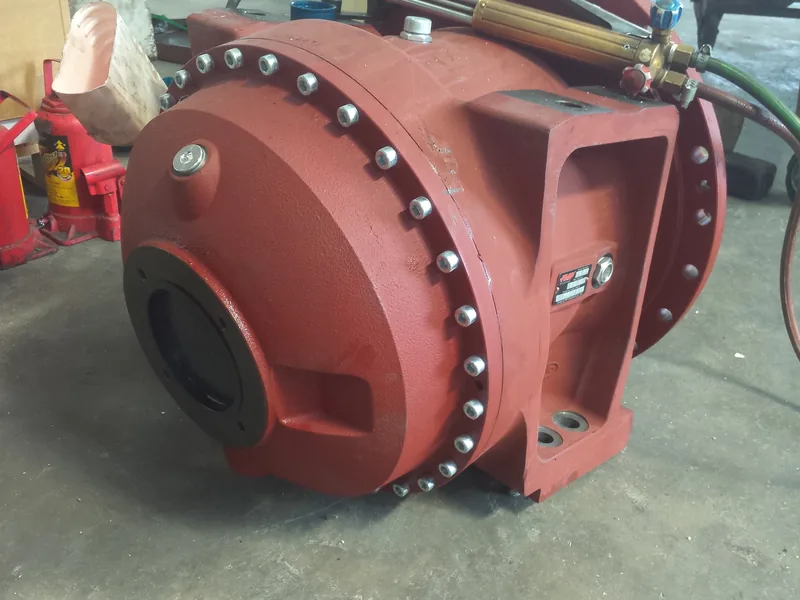
The short answer
For a 6–12 m³ mixer truck, the gearbox is one of three PMB sizes we keep on file: PMB 6 (R100) for 6–7 m³, PMB 6.5 (R120) for 8–10 m³ and PMB 7.1 (R120 / R130) for 10–12 m³. Pick the size from the drum, then copy the ratio and part number from the old nameplate. If the plate is unreadable, send us a photograph of the plate plus the pump and motor plates — the three numbers have to agree before we confirm a unit.
We supply these as standard catalogue units, selected by model and part number — not machined to a buyer drawing. That distinction matters: a custom superstructure can be re-dimensioned around your chassis, but a gearbox, pump or motor is either the correct catalogue unit or it is not. The rest of this guide is the check list we use before we confirm one; the PMB series gearbox page carries the full model comparison table.
| Model | Max. output torque | Ratio | Drum capacity | Oil capacity |
|---|---|---|---|---|
| PMB 6 (R100) | 60,000 Nm | 1:100 | 6–7 m³ | 12 L |
| PMB 6.5 (R120) | 65,000 Nm | 1:120 (1:120.3) | 8–10 m³ | 13 L |
| PMB 7.1 (R120 / R130) | 70,000 Nm | 1:120 or 1:130 | 10–12 m³ | 15 L |
Catalogue references for the three PMB sizes currently on our product page. Capacity bands are a selection guide; the ratio and part number on the drum plate decide the order.
1. Start with the drum, not with the torque figure
Drum volume is the practical starting point because it fixes the load the gearbox has to turn: a full 12 m³ drum of wet concrete is a very different load from a 6 m³ drum, and the difference shows up as torque demand at the output. The published PMB figures rise in steps — 60,000 Nm for the PMB 6, 65,000 Nm for the PMB 6.5 and 70,000 Nm for the PMB 7.1 — and those steps line up with the 6–7, 8–10 and 10–12 m³ bands.
Two things make this a band rather than a formula. Concrete density varies with the mix and the aggregate, and a truck that spends its life on steep site ramps loads the drive differently from one doing flat urban deliveries. The drum's installation angle, the condition of the roller track and the rolling ring, and how full the drum actually runs all shift the real load. This is why we ask what the truck does, not only what its nominal capacity is.
Do not size up "for safety" without checking the rest of the line. A larger gearbox with a different ratio changes the drum speed at the same pump flow, and the mounting lugs, flange and oil quantity change with it. Oversizing a single component without matching the hydraulics is a common reason a replacement drum turns too fast or too slowly after fitting.
- 6–7 m³ → PMB 6 (R100), 60,000 Nm, ratio 1:100
- 8–10 m³ → PMB 6.5 (R120), 65,000 Nm, ratio 1:120 (1:120.3)
- 10–12 m³ → PMB 7.1 (R120 / R130), 70,000 Nm, ratio 1:120 or 1:130
2. Read the nameplate before comparing part numbers
The letter-and-number code on the plate is the part number. R100, R120 and R130 are not marketing names: they identify the reduction ratio family, and a PMB 7.1 can be supplied with either R120 or R130. A unit that looks identical on the pallet can therefore turn the drum at a different speed. Before you order, photograph the plate and write down five things: model, part number, ratio, flange and bolt pattern, and shaft rotation.
Our own photographs show why this is worth the five minutes: the housing, the ring of bolts and the output flange look almost the same across the range, while the input flange and the mounting lugs differ. Where the original has been superseded, we confirm the nearest current equivalent in writing before payment rather than shipping something that "should fit".
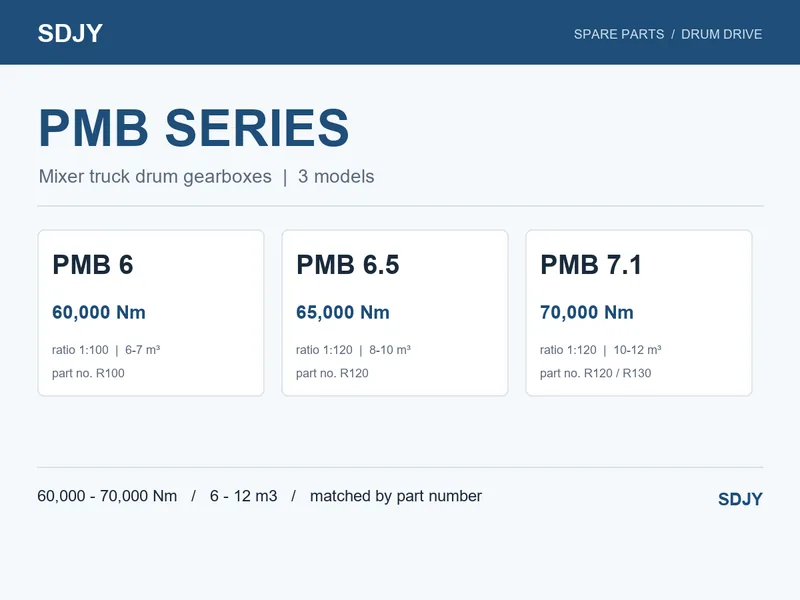
The comparison table above and the range card below show the same three sizes we keep in our catalogue. We deliberately no longer list the larger 7.5, 7.8 or 9 sizes on that page: our stocked range is the 6–12 m³ band. If your truck is above 12 m³, send the plate and we will check availability rather than quote a size we do not hold.
3. Match the whole drive line, not one component
A mixer drum drive is a closed hydraulic loop: a variable-displacement pump feeds a fixed-displacement motor, and the motor drives the drum through the gearbox. In the PMH range we supply, the P 72 / P 90 / P 110 pumps pair with the M 72 / M 90 / M 110 motors and the PMB sizes above. The pump displacement sets how much oil is available at a given engine speed; the motor displacement turns that flow into shaft speed; the gearbox ratio turns it into drum speed. Change one number and the drum speed changes with it. The comparison tables sit on our PMH P pump page and PMH M motor page.
The PMH M motors are rated for 500 bar peak pressure (480 bar nominal) with an integrated flushing valve, and the PMH P pumps use the same 500 bar peak technology with manual MS, electric proportional EP, or MY / RE controls. An optional valve block can add a flushing valve, by-pass, dead-man or cut-off function. Controller type and shaft rotation are part of the order — they are not details that can be swapped on site.
| Pump | Displacement | Motor | Displacement | Matched gearbox |
|---|---|---|---|---|
| PMH P 72 | 72.1 cc/rev | PMH M 72 | 72 cc/rev | PMB 6 / 6.5 |
| PMH P 90 | 89.2 cc/rev | PMH M 90 | 90 cc/rev | PMB 6.5 R120 |
| PMH P 110 | 110.0 cc/rev | PMH M 110 | 110 cc/rev | PMB 7.1 R130 |
These are the pairings published on our PMH P and PMH M product pages, not an official PMP kit number. Confirm displacement, flange, shaft rotation, controller and part number on each nameplate before ordering.
4. Oil, mounting and the checks before dispatch
The catalogue oil quantities are 12 L for the PMB 6, 13 L for the PMB 6.5 and 15 L for the PMB 7.1, with a maximum input speed of 2,500 rpm across the three. Dry weights run from 250 kg to 305 kg, so handling and the mounting angle are real workshop concerns, not footnotes. Fit the unit to a clean flange, use the specified bolt torque and fill with the oil grade in the service manual before the first run.
These are stock items: pressure and run tested before dispatch, with a lead time of around seven days, and no drawing or tooling cycle. What we cannot do is machine a custom flange or alter a ratio to suit a chassis — that is a different product and a different conversation. If you need a superstructure matched to your chassis instead, that is our built-to-order line.
- Photograph the gearbox, pump and motor plates together
- Confirm ratio, flange, bolt pattern, shaft rotation and controller in writing
- Check oil quantity and grade before the first run
- Re-check drum speed under load after fitting
5. Where this guide stops
The capacity bands and the pump / motor pairings above are selection references compiled from PMP catalogue data and the configurations we see on real trucks — they are not an official PMP kit number, and PMP does not publish a capacity-to-model cross-reference. Torque, weight, oil quantity and speed figures come from the published PMB and PMH tables; where dealer sheets disagree, our product pages say so. For a quotation, the nameplate is the authority, not the band.
Electric drum drives are a separate case again. The 7.5E-style electric package uses its own reduction and motor arrangement and is not a like-for-like hydraulic spare; do not order a PMB 6 / 6.5 / 7.1 against an electric drive without checking the whole system first.
Common questions
Can I fit a PMB 7.1 on a 8 m³ drum?
Physically it may bolt up, but the ratio and output speed will not necessarily match the original, and the hydraulic line was sized for the smaller unit. We would ask for the old plate and the pump and motor plates first. A like-for-like replacement is almost always the safer order.
What if the nameplate is missing or unreadable?
Send photographs of the gearbox from both sides, the pump and motor plates, the drum volume and the chassis model. We compare the flange, bolt pattern and ratio family against the catalogue range and confirm the unit in writing before payment.
Do you machine gearboxes to a drawing?
No. Gearboxes, pumps, motors and wear parts are standard catalogue units supplied as built. Custom machining applies to our built-to-order superstructures, barrels and trailers, where a chassis-matched drawing is produced before production.
How fast can you ship?
Stock units are pressure and run tested before dispatch, with a typical lead time of about seven days. The exact window is confirmed with the quotation because it depends on the part number and destination.
The three product pages in this guide
Send the plate, get a confirmed unit
Tell us the drum volume and send photographs of the gearbox, pump and motor plates. We reply with the exact model, ratio and part number — or the nearest current equivalent — plus price and a delivery window.